
Surfaces Poured to Order, Not Prefabricated
Countertop epoxy in Walton for kitchens, bars, and workspaces with dated or damaged surfaces
Kitchens and bar areas in older homes across Walton and Delaware County were often built with laminate or tile surfaces that have since aged past the point where refinishing makes sense. Epoxy Creations LLC works directly with homeowners and property owners who want a seamless, custom-poured surface without tearing out the underlying structure. What changes after the work is complete is immediately visible: a continuous, non-porous top with no grout lines, no seams, and a color or pattern chosen by the customer before a single drop is poured.
The process starts with an on-site measurement so the pour is sized precisely to the counter. The owner then discusses color, pattern, and edge profile with the customer before any fabrication begins. Countertop epoxy is among the earliest services Epoxy Creations LLC developed, and the finished work is documented on the shop's Facebook page for anyone reviewing past projects before making a decision.
Arrange an on-site measurement to review your current surface condition and talk through color and pattern options before committing to a direction.
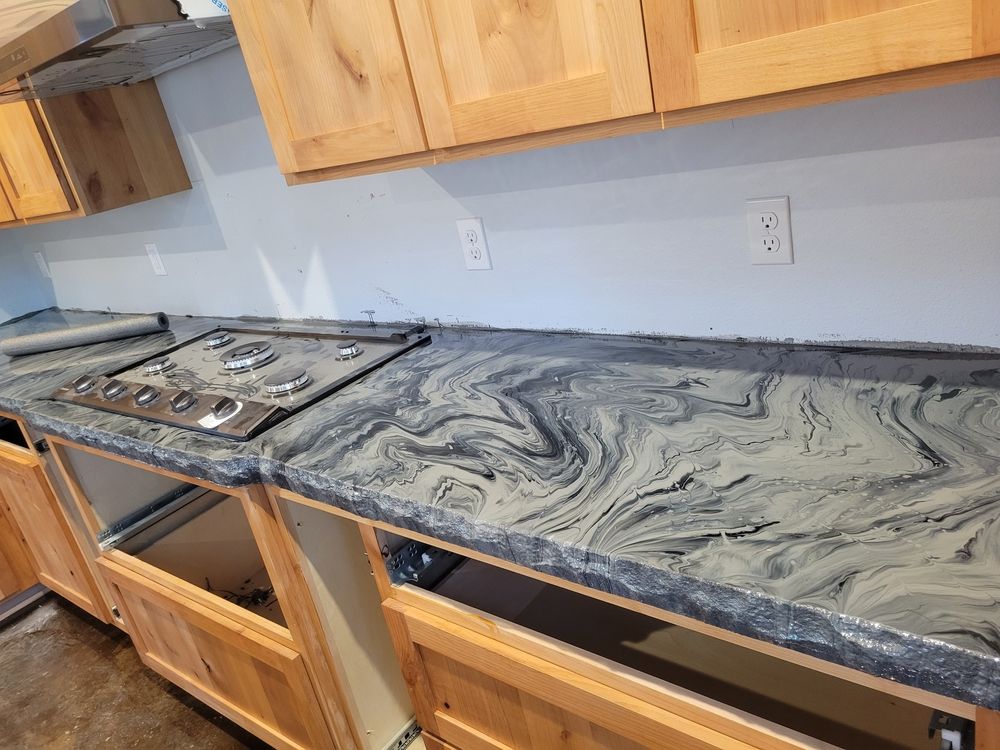
How a Poured Epoxy Top Is Built and Finished
Countertop epoxy is not applied in a single coat. The surface beneath it must be prepared so the epoxy bonds correctly and does not lift or bubble at the edges. After preparation, the epoxy is poured in layers, with each layer given time to set before the next is added. This staged approach controls thickness and allows color or pattern elements to be placed deliberately rather than mixed randomly.
Once the final layer has cured fully, the top is finished to a consistent sheen across the entire surface. What customers notice at that point is a hard, smooth top that responds to cleaning the way a solid-surface material does—no grout to scrub, no laminate edges to catch moisture, no visible repair lines from wherever the old surface had failed. The cure timeline is communicated before the counter goes back into use, so there is no guesswork about when it is ready for normal activity.
Edge profile is a decision made during the consultation and affects how the finished top meets the cabinet or bar face. Straight edges, rounded edges, and built-up edges each change the visual weight of the counter, and the right choice depends on the depth of the substrate and the surrounding cabinetry. Workshop counters and bar tops follow the same pouring process as kitchen surfaces but are typically finished to a higher build thickness where impact resistance matters.
What Property Owners Ask About the Work
These questions reflect what homeowners and property owners in the area typically want to understand before a countertop epoxy project begins.
What surface preparation happens before the epoxy is poured?
The existing counter must be clean, dry, and structurally sound before any epoxy contacts it. Loose laminate edges, soft substrate sections, or old adhesive residue are addressed during prep so the bond is consistent across the full surface.
How are color and pattern decisions made before the pour?
The owner reviews options with the customer during the on-site consultation, working from color samples and finished project photos so the customer can see what a given combination looks like in a completed top rather than guessing from swatches alone.
Why is epoxy poured in layers rather than all at once?
Thick single pours generate heat as the epoxy cures, which can cause bubbles, cracking, or uneven surfaces. Staged pouring controls the exothermic reaction and allows each layer to cure cleanly before the next is added.
How does an epoxy countertop hold up in a kitchen or bar setting used daily?
A properly cured epoxy top is non-porous and resistant to staining from typical kitchen use. The finished surface does not require sealing the way natural stone does, and spills that sit on the surface do not penetrate it.
What should you look for in a finished epoxy countertop to confirm the work was done correctly?
A well-finished top has a consistent sheen with no visible dips, bubbles, or cloudy patches. Run your hand across the surface—it should feel uniform from one end to the other, with no high spots at layer transitions or rough patches near the edges.
Epoxy Creations LLC also installs countertop epoxy in Sidney, Oneonta, Stamford, Hancock, and Binghamton. Contact Epoxy Creations LLC directly at (607) 644-2211 to schedule an on-site measurement and walk through the design options for your kitchen, bar, or workspace counter.