
A Finish With Depth That Bare Concrete Cannot Produce
Metallic Epoxy Flooring in Walton for garages, basements, and finished spaces where surface variation in older concrete needs a design-forward solution
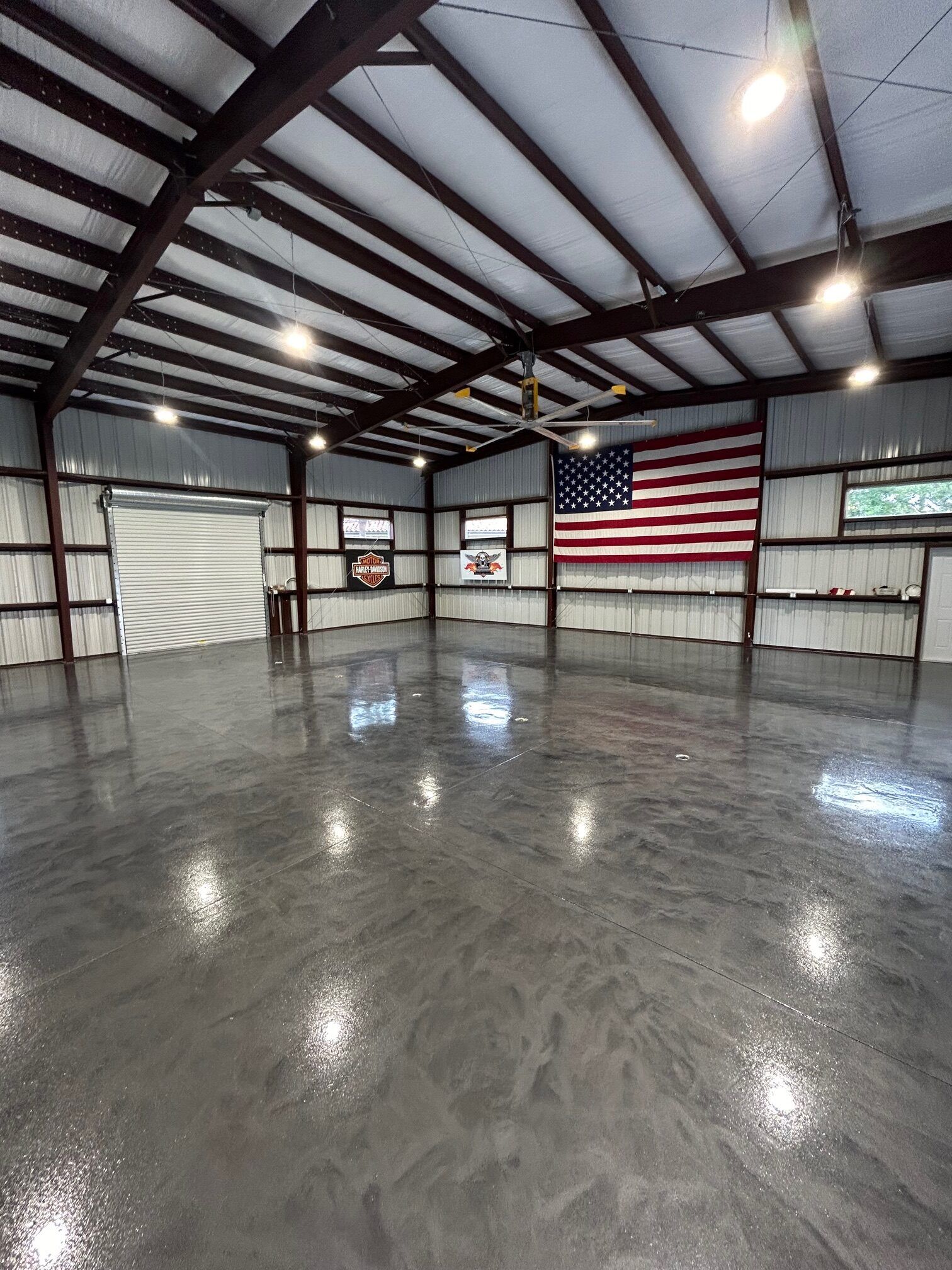
After metallic epoxy cures, the floor reads differently depending on the angle you view it from—swirling pigment suspended in a clear top coat creates a reflective, three-dimensional finish that shifts as light moves across the surface. Epoxy Creations LLC installs metallic epoxy floors in Walton for homeowners who want a showpiece result in a garage, basement, or finished interior space. The shop has completed metallic finishes and documents each one on Facebook so you can review the actual depth and movement of the pattern before choosing a color.
Metallic work is timing-sensitive in a way a standard base-coat-and-flake system is not. After the concrete is cleaned, repaired, and ground, a pigmented base coat is applied, then metallic pigments are worked into the epoxy while it is still wet to create the swirl and movement—once the epoxy begins to set, the window to manipulate the pattern closes. Epoxy Creations LLC plans the pour and cure schedule around the temperature of the slab because cold concrete slows the working time and changes how the pigment distributes, which affects the final pattern directly.
Request an on-site visit to discuss color options and review how the metallic finish will read on your specific slab before work is scheduled.
Why Timing and Slab Temperature Drive the Result
The difference between a metallic floor with consistent depth and one with flat or uneven pigment distribution usually comes down to how the pour was managed against the concrete temperature. Epoxy Creations LLC accounts for slab temperature when scheduling metallic work because a slab that is colder than the ambient air affects how quickly the epoxy sets and how the metallic pigments move and settle through the wet film.
Once the clear top coat is applied and fully cured, the finished floor has a reflective quality that amplifies available light in spaces like basements and garages where natural light is limited. The swirling pattern also effectively conceals minor surface variation and old repair areas in older concrete, which is one reason homeowners in Walton and nearby villages with older poured slabs often choose a metallic finish over a solid-color system where every surface imperfection is visible beneath a uniform coat.
The on-site visit includes a color discussion so the pigment combination is chosen before any material is ordered or work is scheduled. Color choice, slab condition, and room dimensions all factor into how the pattern will ultimately read across the full floor—decisions made in person rather than from a sample card produce results that match expectations when the top coat is peeled off and the floor is revealed.
What Property Owners Ask About the Work
These questions address the mechanics of metallic epoxy installation—how the pattern is created, what affects it, and how you evaluate a finished result before and after the top coat goes down.
How is the metallic pattern actually created during application?
Metallic pigments are added to the wet epoxy and then worked—using tools and air movement—while the material is still in its open time, so the swirl and movement in the pattern is produced during application rather than being a printed or fixed graphic.
Why does slab temperature matter more for metallic work than for a standard flake system?
Metallic pigment manipulation depends on the epoxy remaining workable long enough to move the pattern; a cold slab shortens that window, while a slab that is warmer than expected can extend it, and both conditions require adjusting the application approach in real time.
What surface preparation does a metallic floor require compared to a standard epoxy coat?
The prep steps are the same—clean, repair, grind—but the surface flatness matters more with metallic finishes because the reflective top coat amplifies any unevenness in the base, making thorough grinding especially important for older or uneven poured slabs.
How do older concrete slabs in Walton homes affect the appearance of a metallic finish?
The swirling pattern in a metallic system is particularly effective at concealing surface variation and past repair patches that would be obvious beneath a solid-color coat, which is one reason metallic finishes are a practical choice for decades-old slabs common in Delaware County homes.
What should a finished metallic floor look like to confirm the top coat was applied correctly?
The clear top coat should be even in thickness with no dull or hazy areas, the metallic pattern should be visible at depth rather than sitting flat on the surface, and there should be no clouding where moisture was trapped between the base and top coat.
Epoxy Creations LLC also installs metallic epoxy flooring in Sidney, Oneonta, Stamford, Hancock, and Binghamton. To review completed metallic projects and discuss the color combination and pattern style suited to your space, connect with Epoxy Creations LLC and schedule an in-person consultation before any materials are selected.