
Heavy-Use Floors That Hold Under Real Equipment
Industrial Epoxy Flooring in Walton for barn floors, farm shops, and working slabs that carry heavy machinery and vehicles
Barn floors, farm shops, and equipment buildings across the hill country of Delaware County carry loads that most residential or light commercial floors never see—tractors, loader wheels, and steel-wheeled implements concentrate weight onto narrow contact points that stress concrete and any coating applied to it. Epoxy Creations LLC handles industrial epoxy flooring in Walton for working buildings where the floor must hold under that kind of use without delaminating or cracking through. A walk-through on site confirms what the slab is dealing with before any system is specified.
The owner inspects the concrete during the site visit and discusses exactly what equipment operates on the floor and how it moves—a floor that sees a tractor parked in one bay needs a different build than one with rolling equipment that tracks across the full surface repeatedly. Cracks are repaired and the concrete is ground for mechanical bond, then the system is built in layers: base coat, broadcast if chosen, and a durable top coat cured between applications. Heavier or multi-layer builds are scoped and quoted on site so the specification matches the load, not a standard package.
Set up a walk-through to have your slab inspected and your equipment load factored into the coating specification before any work is scoped.
What Industrial Epoxy Actually Accomplishes
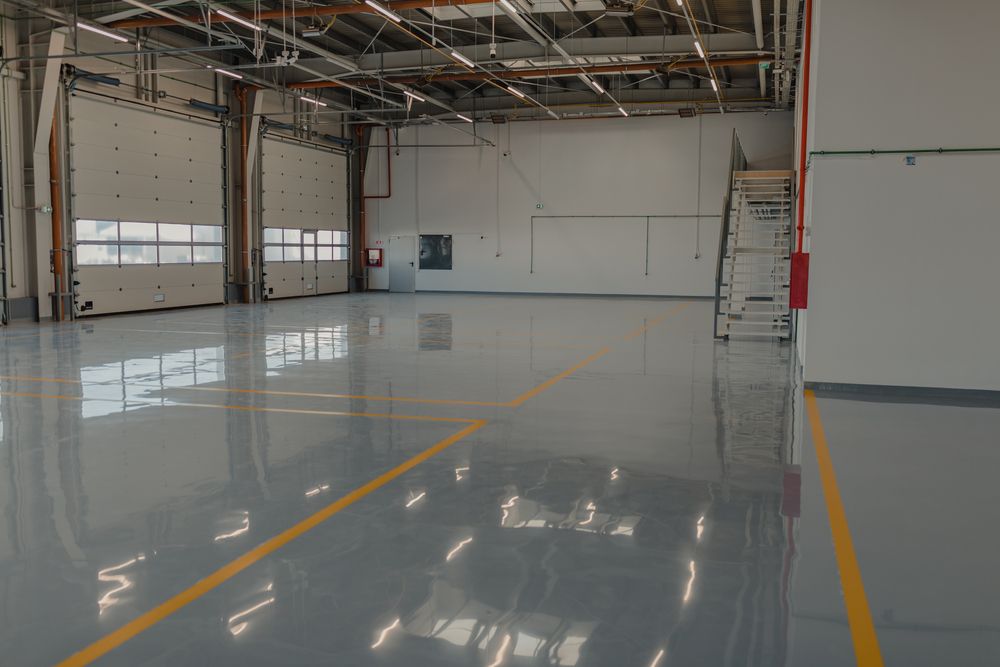
An industrial system differs from a standard garage coat in build thickness and abrasion resistance. On a working floor, the top coat takes direct contact from steel wheels, sharp implements, and dragged equipment, and it needs to distribute that impact without cracking through to the base coat or the concrete beneath. Epoxy Creations LLC selects the system based on what the owner observes during the site visit rather than applying the same specification to every barn or shop floor regardless of use.
After the coating cures, fluids—oil, fuel, animal waste on barn floors—remain on the surface and can be cleared with a floor squeegee or mop rather than soaking into cracked or porous concrete where they accumulate and cause long-term surface degradation. The sealed surface also makes it easier to spot cracks or damage in the concrete itself, since there is no surface contamination masking the slab condition underneath.
Epoxy Creations LLC documents finished industrial and farm-building jobs on Facebook, giving you a reference point for what the finished floor looks like in a working building rather than a showroom. The quote written after the site walk breaks out prep, system build, and coat count, so the price reflects the actual specification for that floor rather than a figure adjusted after work starts.
Questions Before Starting Your Project
The following questions address how industrial epoxy flooring is assessed, specified, and applied in working buildings, and what to look for in a finished result that will hold under heavy use.
Why does the type of equipment on the floor change the coating specification?
Narrow steel wheels and point loads from equipment like loader forks concentrate stress into small areas, which requires a thicker build or higher-abrasion top coat than a floor used primarily for foot traffic or rubber-tired vehicles.
How are cracks in a barn or shop slab handled before the epoxy goes down?
Active or structural cracks are filled with a repair compound suited to that crack type and allowed to fully cure before grinding begins, so the repair is part of the prepared surface rather than a weak point under the coating.
What does multi-layer or thicker build mean in practical terms?
Rather than a single base coat and top coat, a heavier system may include an intermediate coat or a thicker mil application that builds up the total film thickness, increasing resistance to impact and abrasion from equipment contact.
How do farm building slabs in Delaware County typically differ from residential pours in terms of condition?
Working building floors in the Walton area are often older pours that have absorbed decades of oil, fuel, and animal waste, meaning surface contamination is deep enough that mechanical grinding is the only reliable way to reach clean concrete for bonding.
What should you check on a finished industrial floor to confirm the coating bonded correctly?
The surface should not flex or sound hollow when tapped across the field, edges should be tight to the wall without lifting, and the top coat should be uniform without thin areas where equipment contact is concentrated.
Epoxy Creations LLC also installs industrial epoxy flooring in Sidney, Oneonta, Stamford, Hancock, and Binghamton. To get a specification matched to your building and equipment, contact Epoxy Creations LLC to arrange a floor inspection and walk the space before the quote is written.